
How One Giveaway Led to 74 New Subscribers (at a Subscriber Acquisition Cost of 33 Cents Per Subscriber)

How One Giveaway Led to 74 New Subscribers (at a Subscriber Acquisition Cost of 33 Cents Per Subscriber)

In May I launched The Unapologetic Romance Reader. It’s a free weekly newsletter sharing romance recommendations, author Q&As, free books, and new releases. I have a lot of hopes for what it could become. I’d like to commission writers and do some cool journalism but that will take time.

But I wasn’t getting a lot of traction. I had struggled up to 100 subscribers. I was looking for a way to jumpstart my subscriber growth and I decided that a giveaway would be a great idea.

My subscribers are big fans of books, so I figured a $25 bookshop.org giveaway would be a perfect thing that would help me get more subscribers. And it was a really good plan to be honest. I got 74 new subscribers in a week, and I got that off of a $25 bookshop.org gift card, making my subscriber acquisition cost about 33 cents a person. That exceeded my expectations. Here’s how I made that happen.

Think about what you want and what your subscribers want

A bookshop.org gift card was an obvious choice for my audience. This would have been less successful had I gone with something unrelated to their interests. I wanted, more than anything else, more subscribers. I also wanted to make it really easy for people to enter to win.

Set up a survey

beehiiv’s audience tools are unmatched. I already include a poll at the end of every issue and a welcome survey that prompts new subscribers to tell me about what they want to see in Unapologetic, so I’m very familiar with how to use them. Everything is optional. Subscribers could follow on Threads and Instagram, and check their voter registration status to get extra entries. To fill out the survey and get their extra entries, people must be subscribed.

I made really simple drop-down questions where subscribers just had to confirm that they had followed on Threads, on Instagram, and they had checked their voter registration status. None of these were required, so people could do all of them, or just one. I wanted to make it really easy on people.

I ran this on the honor system and I think the vast majority of people were honest. Since this was through a survey, I had no way to authenticate entries, but looking at the growth I had on Threads and Instagram shows this was effective. I also wanted to run this on the honor system because I wanted to encourage my subscribers to vote. My number one priority was getting new subscribers.

The backend of how a beehiiv survey was set up. I said follow us on threads and then people had the option to select from the dropdown "I followed" to confirm.

Set up a page

Create a page on your website so you have something to share on social media. beehiiv makes it easy to set up internal pages on your website. Go to “website builder” hit “custom pages” and then create an internal page. I made a basic giveaway page because I wanted to be able to reuse it in the future for other giveaways. The URL just uses the word giveaway so I can adapt the page to any kind of partnership I do in the future.
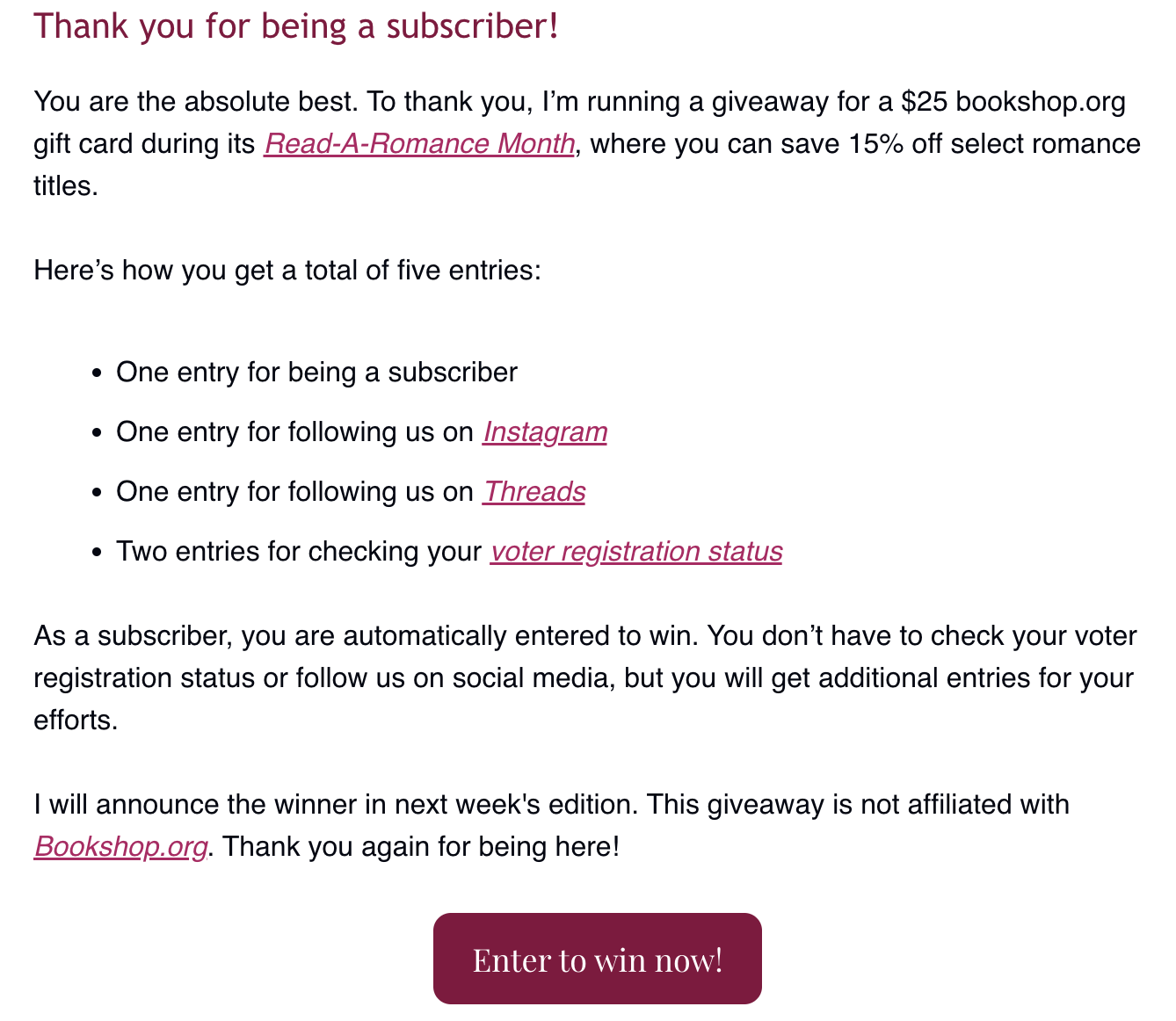
Thank you for being a subscriber!
You are the absolute best. To thank you, I’m running a giveaway for a $25 bookshop.org gift card during its Read-A-Romance Month, where you can save 15% off select romance titles.

Here’s how you get a total of five entries:

One entry for being a subscriber

One entry for following us on Instagram

One entry for following us on Threads

Two entries for checking your voter registration status

As a subscriber, you are automatically entered to win. You don’t have to check your voter registration status or follow us on social media, but you will get additional entries for your efforts.

I will announce the winner in next week's edition. This giveaway is not affiliated with Bookshop.org. Thank you again for being here! Enter to win  now

Promote the hell out of it

I first announced the giveaway in my newsletter at the very top with a banner image and a short note about the giveaway. I linked directly to the giveaway survey and the giveaway page I had made.

a banner image and a short paragraph at the top of a newsletter promoting the giveaway

I shared the giveaway on the newletter’s Instagram and Threads accounts and reshared those posts to my personal accounts. I also shared a little about how I was doing the giveaway using beehiiv on Twitter and LinkedIn. LinkedIn was suprisingly the number one driver of subscribers with Threads coming in second.
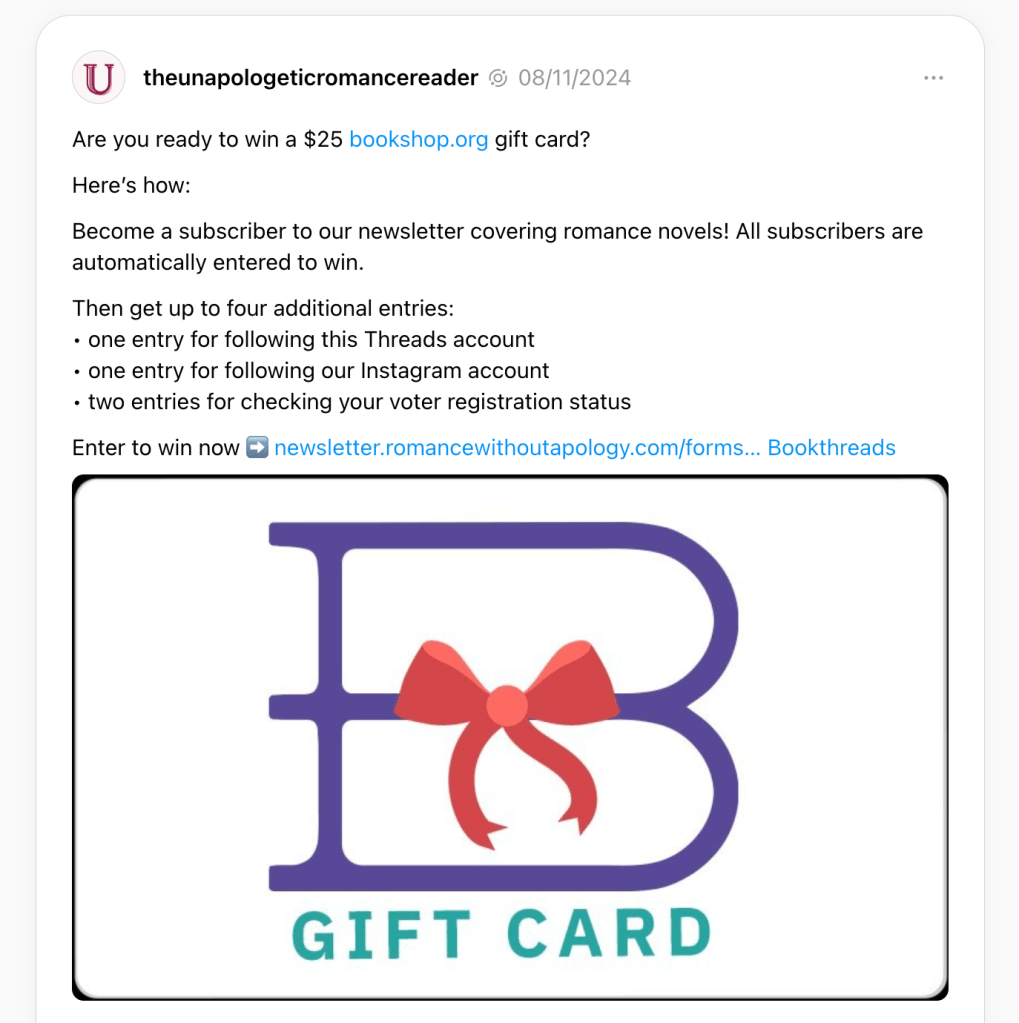
a post on threads about the giveaway

It was also worth sharing on social media because I got more feedback from users.
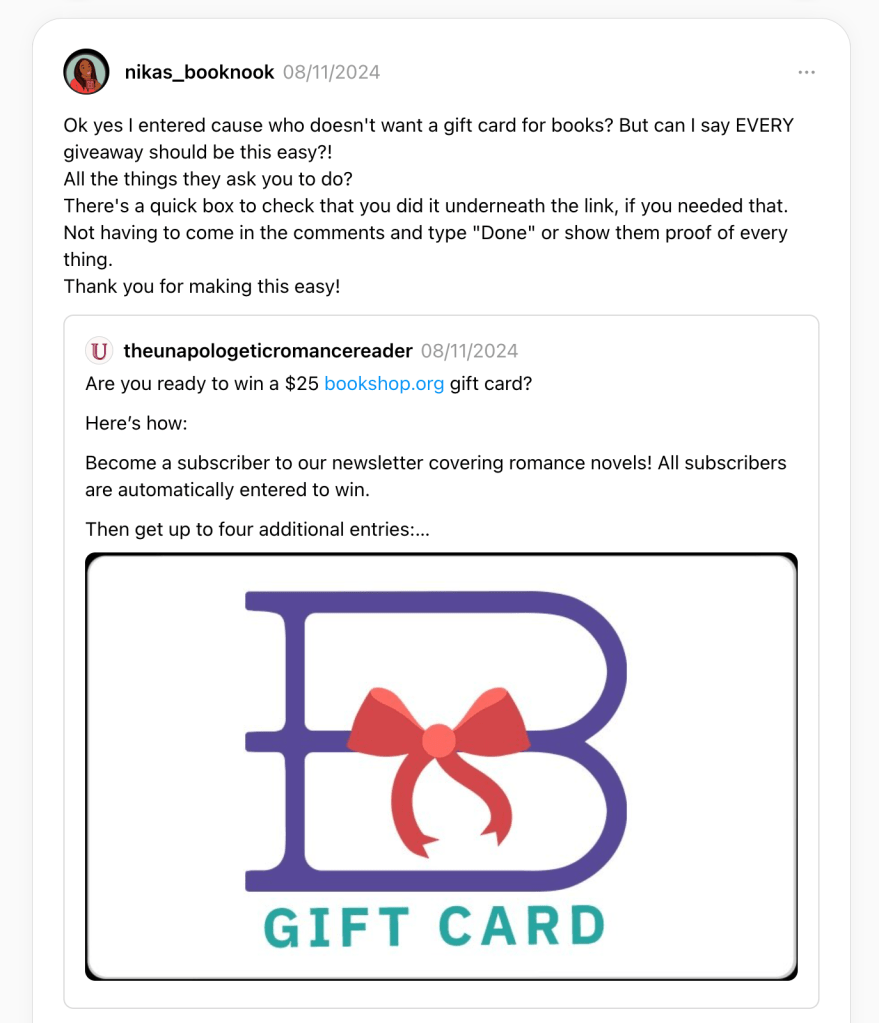
a threads user says that this giveaway was so easy and she appreciated that

Write to one person

Remember, always write your newsletters to one person. A newsletter is a one-to-one communication device. So every time I wrote about how subscribers could win a gift card, I always said YOU can win a gift card. YOU are automatically entered to win as a subscriber. Don’t point out that they have competition. Invite them into the giveaway.

Create a firm deadline

When I announced the giveaway I told everyone that the winner would be announced in the next edition. I wanted subscribers to have to see at least one edition of the newsletter. I thought some people would probably unsubscribe following the announcement and I wanted the opportunity to prove Unapologetic’s worth.

Select and announce a winner

I used Rafflys’ Wheel Picker to choose a winner. I entered everyone’s entries manually. This was the most time consuming part of the process. You could probably chose to do something simpler to choose a winner.

I then announced the winner in the most recent edition. I recommend setting up a welcome email where you collect people’s first names so it’s easier to announce who won.

 Giveaway Winner
Many thanks to all of you for entering to win a $25 bookshop.org gift card! I plan to have more giveaways in the future and announcements for that will always come from this newsletter. Congratulations to Oseias for winning! The gift card is in your inbox now.

Let them know that there will be more giveaways

This giveaway was successful so I plan to have more in the future. When I announced the winner, I told subscribers that there will be more chances to win in the future. I also reset the giveaway page and asked subscribers about what giveaways they want to see next.

Thank you for being a subscriber!
You are the absolute best. As a subscriber, you are automatically entered to win giveaways. More details will be shared here and in the newsletter when a giveaway starts, so keep following along!

It’s worth incentivizing growth

I know 74 subscribers isn’t a lot in the grand scheme of things, but it’s a lot to me. I wasn’t sure if anyone would subscribe when I first started Unapologetic. Some weeks it’s been hard to find the time to get out an issue. While the newsletter hasn’t cost me money, it also hasn’t made much (about $6 from beehiiv boosts so far).

But I love romance. I’ve missed recommending books to readers (which I used to do regularly as a library clerk). I’ve watched publications freeze their freelance budgets and dedicate less coverage to books. I believe in the future of independent media and I’ve learned a lot from curating Freelance Opportunities! So I’m hopeful for the future of this publication and I’m excited to keep developing it.

I’m glad I went with beehiiv

When I chose beehiiv as the official home of Freelance Opportunities!, I knew that I could add two more publications without incurring more fees but I didn’t think I’d ever want to. I’m so glad I went with my heart and started Unapologetic.

beehiiv has made it possible for me to:

  • Launch Unapologetic for free without upgrading my plan (I’m on the scale plan)
  • Use polls and surveys to better understand my audience’s interests
  • Start monetizing early (beehiiv sent me three ad opportunities before I had 100 subscribers)
  • Make money (I’ve made $6 with Apologetic, but I’ve made thousands with beehiiv)
  • Become a better newsletter operator with the hiiv community

If you chose to go with a paid beehiiv plan and use my affiliate link, I will happily do a free one-on-one consultation where I’ll share my thoughts about improvements you can make to your existing newsletter. If you haven’t started one yet, I’ll talk to you about how to hit the ground running.

Subscribe To These Free Newsletters If You Want To Become A Creator

Subscribe To These Free Newsletters If You Want To Become A Creator

As I’ve become a professional independent writer, I’ve studied a lot of other creators to see how they run their businesses. You don’t need to recreate the wheel! These free newsletters offer a lot of knowledge about building an independent business.

1. Creator Spotlight

This is my favorite newsletter on the market right now. I open it every time it’s in my inbox. I cannot believe it’s free. Creator Spotlight also stands evident to the fact that newsletters don’t have to be ugly. I especially love the issues on Cheapskate London and Naptown Scoop.

2. Newsletter Operator

There’s always helpful DIY tips on how to make your newsletter better, and some overall news about the newsletter industry itself. Every creator or freelancer should have their own website and newsletter, and this is where you’ll learn about how to connect with your audience without relying on an algorithm.

3. Creator Science

Another email I open without fail because there’s always some brilliant insights included. Jay knows how to build a creator business and has rock solid advice. I can also vouch for his masterclasses on building communities. Whenever I hear him speak, I end up with five pages of notes. I’m so glad he distills some of that knowledge into a weekly newsletter.

4. The Creator’s Toolbox

I always find a new tool to use here, or some tips about how to use something better. Working solo means that I need to know about tools that make my life easier.

5. Growth in Reverse

I read every issue! Chenell profiles large and small creators to learn about how they grew their businesses and how you can do the same.

6. Creators Getting Paid

Michelle shares case studies, growth strategies, and insights on building your own business.

7. Ultimate Tools

Okay, this newsletter also recommends tools, but I love the ongoing trends and news included in every edition. It’s also specifically about marketing, which is something every freelancer and creator needs to know about!

8. Mindset Mastery

Being self-employed in any way requires balance and staying sane even when chaos is all around you. Jenni shares amazing tips about staying mentally and emotionally well while building your own business.

9. Journalists Pay Themselves

Written by the one and only Lex Roman, Journalists Pay Themselves chronicles how worker-owned publications work and how journalists can make a living working independently. If you’ve ever thought about starting a local newsletter or working independently, subscribing to Journalists Pay Themselves is a no brainer. I especially liked her piece on Oliver Darcy starting Status on beehiiv.

10. Not the Same Old Tools

Huge fan of looking through past newsletter editions to find new tools. I like things that make my life easier!

11. Total Annarchy by Ann Handley

Ann takes her sharp pen and slices through marketing bullshit every single week and I love it so much. On a serious note though, you will learn so much about content marketing from her.

12. Low Energy Leads

How do creators find clients? Low Energy Lead answers all of those questions. Whether you’re building a newsletter or freelancing for the first time, Low Energy Leads will help you find a new way to connect with people.

13. Creator Wizard

Justin Moore is single handedly responsible for me taking sponsorships seriously and making them a part of my business. If you’re not a newsletter person, then please subscribe to his YouTube.

14. Link in Bio

Link in Bio chronicles the business of social media. It has resources for social media managers and features free weekly interviews with professional social media people. It’s most helpful if you want to work in social media, but I think anyone interested in monetizing their social media can learn from Link in Bio.

15. The Tilt

A twice weekly newsletter for anyone working in content. The Tilt always includes information on social media changes, the business of content, and helpful resources.

16. Tubefilter

Tubefilter always has ongoing creator news. It’s probably best for influencers and people interested in social media.

17. Freelance Opportunities!

Let’s be real, you will probably need to make some money as you build an independent business. A lot of creators (including people mentioned above) started as freelancers or freelanced on the side. My newsletter shares paid opportunities so you can make money wherever you are in your career and wherever you are in the world.

18. The Loaf

I don’t think there’s a better name for a newsletter. If a company called Creator Bread didn’t name its newsletter The Loaf it would be a crime against humanity. The Loaf talks a lot about the financial realities of being independent and shares financial advice.

19. Frootful Creator

I love using Passionfroot to manage my sponsorships. Though Frootful Creator is no longer published regularly, it’s archives provide a lot of value. Passionfroot’s podcast, Creators on Air, is also a study in going solo.

20. Newsletter Business

I think every creator should have a newsletter. I invested a lot of time and energy on Twitter only to watch it become a shell of itself. When you have a newsletter, you own your audience and can make more revenue than you can with social media alone. Newsletter Business shares tactics and insights to grow your newsletter.

Did you enjoy this article?

I do my best to make free and affordable resources for you. If you’d like to say thanks:

1. Buy me a coffee

2. Share this article (or any other) with a friend and tag me 

3. Explore my Bookshop

4. Work with me

5. Become a member

Check These 16 Freelance Rate Databases for a More Transparent Look into Setting Freelance Rates 

Check These 16 Freelance Rate Databases for a More Transparent Look into Setting Freelance Rates 

The most common question I get from freelancers is this: how do I price my projects? There’s no simple answer. I wanted to share the databases I’ve personally referenced as well as resources that other freelancers have recommended. These rate databases and resources will help you better price freelance projects.

These resources are just a starting point

Before we examine these rate databases, let me make something clear: these don’t determine what your rate should be. These rate databases reflect what freelancers have been paid in the past for different types of work and for different clients. Some of these databases may have outdated information, or may not have relevant information that helps you. That said: looking through these databases can help you better understand how to price your own projects.

16+ Freelance Rate Databases and Resources

1. ​​Freelancing Females Rate Database

The Freelancing Females Rate Database is one of the most updated rate sheets I’ve found. With more than 1,700 entries, freelance graphic designers, writers, product managers, web developers, social media managers, and producers have shared what they’ve made for projects in different industries and have transparently included their location, gender, experience level, yearly income, and business type (aka full- or part-time).

Don’t be fooled by the name: Freelancing Females is collecting rates from all genders. Freelancing Females is currently updating its rate database with new information, so please take the time to add your details!

2. Contractrates.fyi

Contractrates.fyi is a fairly new rate database that crowdsources rate data for freelancers and consultants. Unlike every other rate database on this list, Contractrates.fyi compiles international rates for a wider variety of roles including plumbers, fullstack engineers, accountants, animators, photographers, WordPress developers, UX researchers, and virtual assistants. Sort by hourly and project rates or by role.

3. The Editorial Freelancers Association Rate Database

The Editorial Freelancers Association surveyed a third of its members in 2024 to get updated rates for copy editors, developmental editors, proofreaders, fact checkers, transcribers, writers, and sensitivity readers. The EFA is a great resource for freelance editors and breaks down rates by page, word, hour, and flat fee.

4. Try Vetted

If you don’t yet have access to Try Vetted’s Reviews and Rates Database, you need to change that ASAP. You can only see Vetted’s reviews and rates database after leaving a review of a brand you’ve worked with. These anonymous reviews on brands big and small include an overall rating, pitch process, project scope, the rate, payment type (ex. hourly, project), and whether they paid on time.

These honest reviews of different brands are illuminating. I would recommend referring to it when vetting potential clients.

A screenshot of the Vetted database that shows the process of how Vetted works by applying, leaving a review, and accessing the database.

5. Association of Independents in Radio

The Association of Independents in Radio has a ton of research on podcasting and radio rates for audio engineers, audio editors, composers, editorial consultants, story editors, mix engineers, producers, reporters, sound designers, and studio engineers. A few of these rate guides are only available to AIR members, but most are open to the public.

6. American Writers and Artists Institute 2024 State of the Industry Report

I had no idea about this one until a few freelance writers recommended it! The AWAI State of the Industry report is the most comprehensive looks at the freelance industry that I’ve seen. It includes fee ranges for different types of copywriting projects like keyword research, articles, landing pages, white pages, ebooks, podcast scripts, book ghostwriting, and audits.

7. A Photo Editor

Though A Photo Editor isn’t a rate database, it does a lot of work to create transparency around how photographers make a living. A Photo Editor has a “Photographers, how much do you make?” series where photographers anonymously share their annual earnings, what they do, and how much experience they have. I’d also recommend following the conversation on Instagram!

8. Who Pays Writers?

Who Pays Writers is so handy that I included a direct link to publications on the Places to Pitch Trello board. Sorted by publication, Who Pays Writers lists various rates and project scopes so you understand who pays well and who…doesn’t. I’ve noted that lately, the homepage can be a little wonky so if it doesn’t work for you, try this link.

The homepage of Who Pays Writers? shows a list of publication titles and selected reviews of pay rates for Cosmopolitan UK and The Washington Post

9. Salary Transparent Street

Salary Transparent Street has a salary database that only focuses on U.S. locations. Like A Photo Editor, it focuses on annual salaries and overall careers over individual project rates.

10. FYPM

Like Vetted, influencers and creators must apply to join FYPM (which stands for F*** You, Pay Me). You must also leave one anonymous review. Don’t be afraid of the word “influencer” here: as long as you’ve made an agreement to promote a brand on your social media, blog, newsletter, or website, you count.

11. Lightbox

Lightbox is a rate database for graphic designers, illustrators, cartoonists, and comercial artists. Lightbox sorts listings by companies, jobs, rates, and year. It also includes whether or not creatives were paid and if they were paid in 30 days.

12. Levels.fyi

Levels.fyi compiles salaries by title, location, and company. Adding your salary unlocks more results. Levels.fyi leans more toward traditional full-time roles, but it’s cool to review.

13. Contently’s Rate Database

Much like Who Pays Writers, Contently’s rate database sorts by publications. You can see the pay, payment method, and notes left by anonymous freelancers. This rate database isn’t my favorite because it hasn’t been updated since 2019 (and a lot has changed since then!).

Freelance Writer Surveys

14. Peak Freelance 2022 Freelance Writing Rates

Peak Freelance surveyed 213 freelance writers in 2022 to better understand freelance rates. The survey found that more than half of freelance writers surveyed earn less than $30,000 a year. Those earning more than $100,000 a year have been freelance writing for at least two years.

15. Ashley Cummings Freelance Writing Rates Survey

Ashley Cummings surveyed 344 freelance writers in 2023. Her survey found that most freelance writers surveyed price per project and 66% of freelancers find new clients through referrals. Older freelancers charge more than younger writers and freelance writers with a bachelor’s degree are charging more per hour than those without.

I particularly enjoyed the section where freelancers share advice on portfolios, pitching, networking, and setting rates.

16. All Things Freelance Writing Freelance Writers Survey

All Things Freelance Writing surveyed 346 freelance writers from 31 countries in 2023 to learn more about the average income of freelance writers, their charging methods, and payment schedules. The survey found that most writers surveyed get paid in full after a project is complete.

More resources for pricing freelance projects

Rate databases and surveys are great, but they’re not the only resource you can rely on. Here’s a few more resources I use as I price freelance projects and sponsorships.

Setting sponsorship rates

As many freelancers expand into offering sponsored newsletter ads and social media posts, understanding how to price sponsorships is crucial.

FYPM is the only database I know of that’s just for sponsorships. I recommend looking through Passionfroot’s Creator Gallery to see what other freelancers and brands charge for sponsorships. Creator Wizard and Newsletter Crew have some great resources on sponsorship rates as well.

I based my sponsorship rates on the size of my audience, the value I provide, and what I thought was fair.

Other resources

Jasmine Williams has a free freelance rate calculator that’s pretty handy. Harlow also has a long list of resources to consult.

Raise your rates with these templates

These email templates will help you raise your rates with existing and new clients. I’ve had many freelancers tell me that they’re effective!

Speaking about your rates is an act of advocacy

So much about freelancing is obscure. By discussing your rates and sharing resources with other freelancers, you can play a part in creating a more transparent culture. Take the time to add your rates to open rate databases. Join freelance communities where you can talk about what freelancers charge for projects. Ask “what’s the rate?” when you see a freelance opportunity posted without a rate range.

Want to support my work?

1. Buy me a coffee

2. Subscribe to my newsletter featuring 100 freelance opportunities every week

3. Share this article (or any other) with a friend and tag me 

4. Explore my Bookshop

5. Work with me

Get new articles focused on freelancing delivered to your inbox.

20+ Free Diverse Stock Photo Sites for Your Site

20+ Free Diverse Stock Photo Sites for Your Site

These websites make selecting quality stock photography easy.

Unfortunately, finding free stock images that show people from underrepresented backgrounds can be a pain. These databases and websites showcase a solid collection of inclusive stock photography. Most of these sites are free but a few are available for a fee or a suggested donation. Many of these sites require attribution so don’t forget that.

People of Color Stock Images

Women Stock Images

Disabled Stock Images

Body Inclusive Stock Images

General Diversity Stock Images

LGBTQ+ Stock Images

And I suggest using these resources to include more marginalized voices in your work.

Want to support my work?

1. Buy me a coffee

2. Share this article (or any other) with a friend and tag me 

3. Explore my Bookshop

4. Work with me

Photo credit: Women in Tech

5 Basic Email Templates for Freelancers Negotiating Higher Rates

5 Basic Email Templates for Freelancers Negotiating Higher Rates

You deserve to be paid more! Ask for the rates you deserve with these templates.

Time to talk about one of my favorite subjects: negotiating a higher rate. As freelancers, we’re business owners, and it’s on us to value our work, time, and skill set. The reality is, you don’t get what you don’t ask for. And if you’re not asking for more money, you’re never going to get it.

Every freelancer needs to regularly raise their rates, but this is especially true for women. In 2019, HoneyBook found that female entrepreneurs are making 26 percent less per project. Men are 4.5 times more likely to earn $150,000 compared to women; comparatively, And Co discovered in the same study that most women surveyed make less than $25,000 a year.

I find negotiating rates easier over email, and that’s easier to do when you’ve got templates to turn to.

1. Negotiating rates on the first assignment

I prefer to not quote a rate because then it’s a game of mind-reading bingo. What if I don’t ask for enough? Would the client find this low or high? Instead, I put the ball back in the client’s court to see what they say.

Hello!

I’m excited to take on this [project/article]. Is there any room in the budget for a higher rate?

Thanks,

[Your name]

2. Negotiating a higher rate for regular assignments

Sometimes you need to revisit the rate on a regular column or writing assignment. Every few months, or after a few articles, ask your editor for a higher rate. Also, make sure that you’re keeping your editor happy by meeting deadlines with clean copy and having good communication with them.

Hi [Editor],

I love [working on this assignment/writing this column]. So far, I’ve done [examples]. I was wondering, is there any room in your budget for a higher rate?

Thanks so much! I love working with you.

[your name]

And I love this one from Tim Herrera:

“Thanks again for this assignment! I just wanted to ask: We’ve done X, Y, and Z stories together, and I’m wondering if with this new assignment we could revisit my rate? I’d love to be at around [rate]. Thanks!”

3. Negotiating a lower scope of work 

Sometimes a client doesn’t have the budget to raise the rate. If you’re still interested in working with them, you can try negotiating a lower scope of work instead. But only do this if you really want to work with them — otherwise, say no to any assignments with them.

Hi there!

I would love to work with you, but that rate is below my fee. I’d like the rate to be around [price]. 

If that’s not possible, I would be happy to connect you with another freelancer who can accomplish this work.

Thank you,

[Your name]

Note: When you have a good client who isn’t paying enough, it’s time to let them go and refer them to another freelancer. If it’s a bad client who isn’t paying enough, throw them into the abyss.

4. Raising your rate because the scope of work has risen

Sometimes an assignment will exceed the scope of work you’ve agreed on. Don’t give them free labor.

Hello!

I’m confident I can accomplish your goals, but this is outside of the scope of work previously agreed on. As per our [contract/email], I will deliver [x] per [date]. I can do [requested scope], but as it is outside of the contract, there will be budget changes. Are you okay paying more for the [outcome]?

Thanks,

[Your name]

5. Raising your rate because it’s time, quarterly, or at a specific time of year

Hi [name],

I adjust my rates every so often to account for market inflation and new skills, which also allows me to provide you with better service! As of [date, my rate will be [price].

If this new rate doesn’t work for you, let me know. I can connect you with another freelancer who can complete this work for you.

Thank you,

[Your name]

Your Next Steps

Negotiation is a skill that takes practice. It takes time to get comfortable talking about money But you have to start somewhere. The next time you take on an assignment, ask for more. The next time a client or editor reaches out with more work, ask for more. You are running a business, not a contestant on The Price is Right.

Want to support my work?

1. Buy me a coffee

2. Share this article with a friend and tag me 

3. Explore my Bookshop

4. Work with me

10 Steps to Take Now to Make Your Freelance Business More Successful

10 Steps to Take Now to Make Your Freelance Business More Successful

It takes time to build a freelance business, but a few simple steps can help set you up for success.

Setting up a freelance business can be intimidating. Here’s a quick list of a 10 things to do to set yourself up for success.

1. Update your website and social profiles

Anywhere potential clients can find you need to be updated to best reflect what you can do for them. That means taking a look at your website, social media accounts, and LinkedIn page, as well as running a quick Google search.

Your social profiles should have a quick elevator pitch about what you do, who you are, and a link to your website. 

Your LinkedIn should have your most recent work experience and a completed bio. List your accomplishments, capabilities, and certifications.

Does every link to your website work? Have you updated your LinkedIn with your most recent work experience?

2. Reach out to your clients and collaborators with thank you notes

It’s always a good time to thank your professional and personal connections! But the beginning of the year is a particularly great time to do this as everyone looks forward to the year ahead.

3. Raise your rates

You deserve to make more money. The new year is the perfect time to raise your rates. I know it’s nerve-wracking, but it’s worth your time.

Clients will typically understand. If they respond with a no, you can always lower the scope of your project to support a lower rate or part ways with them. Plus, letting go of low-paying clients makes time for ones with better pay.

A few ways to start this conversation with clients:

“Due to the high demand for my services, I need to raise my rates to X to continue accommodating you. I love working with your company and look forward to working with you in the future!”

“It’s been great working with you! I just wanted to let you know that starting [DATE], I will be increasing my rate to X. I’d love to keep working with you. I appreciate your business and look forward to working with you in [YEAR]! Please let me know if you have any questions about this new rate.”

4. Make a business plan

If you’re a freelancer, it’s easy to get caught up in the hustle of chasing after clients, submitting work, and running around like a hamster in a cage. But like any entrepreneur, you need to have a business plan set out for yourself.

Ask yourself these questions:

  • What are your long-term goals?
  • What are your dreams?
  • How do you plan to grow your business?
  • What is your target audience? Who do you want to work with?
  • What is your marketing plan?

This is the time to dream big.

5. Make a list of clients, websites, brands, and collaborators you want to work with in the future

Think about the clients you want to land and the clients you want to keep. This list should include anyone you want to work with. Shoot big! Then follow them on social, familiarize yourself with their sites, and take a look at their content calendar to see where you could fit in.

6. Make a commitment to take time for yourself

When you’re chasing down deadlines for multiple clients, it can be hard to carve out time for yourself. But you have to make time for yourself — no one else will do it for you. Otherwise, you’re just running toward burnout.

7. Invest in your education

If you don’t make time to invest in yourself, you’re investing in your future burnout. Make time to learn and invest in your education.

This can mean whatever you want! If you want to learn about SEO, find an online course or certificate program. If you want to learn about finance, read a book. If you want to learn about embroidery, go for it!

You don’t have to necessarily pay for this. There are lots of free resources available and many libraries offer free access to tools like Lynda.com.

8. Review your payment options including your credit cards, debit cards, PayPal, and Venmo

Whatever payment option you use, make a habit of reviewing it every month. Mistakes happens, so watch for errors and unused subscriptions. You should check for any business purchases you’ve forgotten so you can claim them on your taxes. You can also review what rewards your credit card offers, as rewards credit cards can help you maximize everyday expenses.

9. Calculate your monthly expenses

You need to calculate how much money you need to survive to plan your future. This isn’t a budget: it’s a bare-bones list of essential expenses. Making this list gives you a chance to review what you need (and what you can live without). This list should include:

  • Rent or mortgage
  • Health care insurance
  • Car insurance and payments
  • Electricity, water bills, etc.
  • Retirement
  • Investments

Take that expense list and add 30%. That’s your minimum goal.

10. Track and automate your business processes

Make your life easier by automating your business processes. This frees up your time so you’re able to focus on revenue-building tasks like landing new clients, marketing, and completing client work. This could mean using an invoicing service to send invoices automatically instead of manually, or implementing an email tracker to see when your emails are opened.

You should also have a process for onboarding new clients. This could be as simple as sending them a welcome email or just adding them to your calendar. Hiring an accountant or using a digital bookkeeping tool can save you from updating a spreadsheet.

Want to support my work?

1. Buy me a coffee

2. Share this article (or any other) with a friend and tag me 

3. Explore my Bookshop

4. Work with me

Get new articles focused on freelancing delivered to your inbox.

Photo credit: Pexels.com